
Children rarely complain about blurry vision — they simply assume everyone sees the same way. Learn the behavioural clues that suggest your child needs an eye test.
Why Children Can't Always Tell You They Have a Vision Problem
Unlike adults who have experienced clear vision before, children who have had poor vision from birth or early childhood have no reference point. They don't know that squinting, tilting their head, or holding a book very close to their face is unusual — it's simply how they've always experienced the world.
This is why vision screening by parents and teachers — and regular professional eye exams — is so important. In India, studies estimate that approximately 13 million children have some form of uncorrected vision problem. Many go undetected until the critical window for treatment has partially closed.
Important: Amblyopia (lazy eye) must be treated before age 7–9 to achieve the best outcome. After this critical developmental window, the brain's ability to develop full vision in the affected eye diminishes significantly. Early detection is everything.
7 Warning Signs to Watch For
👁️ Frequent Squinting or Closing One Eye
Squinting reduces the amount of light entering the eye and temporarily improves focus — it's an involuntary compensation for blurred vision. If your child squints regularly when watching TV, reading, or looking at the board at school, this is a strong indicator of a refractive error such as myopia (short-sightedness) or astigmatism.
📺 Sitting Very Close to the TV or Holding Books Very Close
Children with myopia (difficulty seeing distant objects) will naturally move closer to whatever they're trying to see. If your child consistently sits within 30–40 cm of the television, holds books directly in front of their face, or leans very close to their school work, this is a classic sign of uncorrected myopia.
🤕 Frequent Headaches or Eye Rubbing
When the eyes are working excessively hard to focus — as occurs with uncorrected hyperopia, astigmatism, or binocular vision problems — the eye muscles fatigue, causing headaches. These headaches typically occur at the forehead or temples and tend to appear in the afternoon after a day of school.
↩️ Tilting the Head or Covering One Eye
Head tilting is often a sign that the two eyes are not working together correctly (binocular vision dysfunction) or that there is a difference in vision quality between the two eyes. The child tilts their head to try to align the images from each eye more comfortably. Similarly, covering one eye may indicate that the vision in one eye is significantly worse or that the child is experiencing double vision.
👥 Complaints of Double Vision or Seeing Things Moving
Double vision in children is never normal and always warrants immediate investigation. It can indicate strabismus (misaligned eyes), neurological issues, or problems with the eye muscles. Younger children may not describe it as "double vision" — they may say things look "blurry," "wavy," or that they see "two of everything."
📚 Difficulty in School, Short Attention Span, or Avoiding Reading
Poor academic performance is not always a learning difficulty — it may be a vision problem. A child who struggles to see the whiteboard, experiences discomfort when reading, or develops headaches from sustained near work may appear inattentive or disinterested when in reality they simply cannot see properly. Vision problems are frequently misidentified as learning disabilities or behavioural issues.
👀 One Eye Turning Inward, Outward, Upward, or Downward (Strabismus)
Strabismus is a misalignment of the eyes — they point in different directions. It is visible to the naked eye and occurs in roughly 3–4% of children. Strabismus can lead to amblyopia (lazy eye) if untreated, as the brain learns to ignore input from the misaligned eye. Early treatment — which may include glasses, patching, vision therapy, or surgery — is highly effective when started early.
What to Expect at a Paediatric Eye Exam
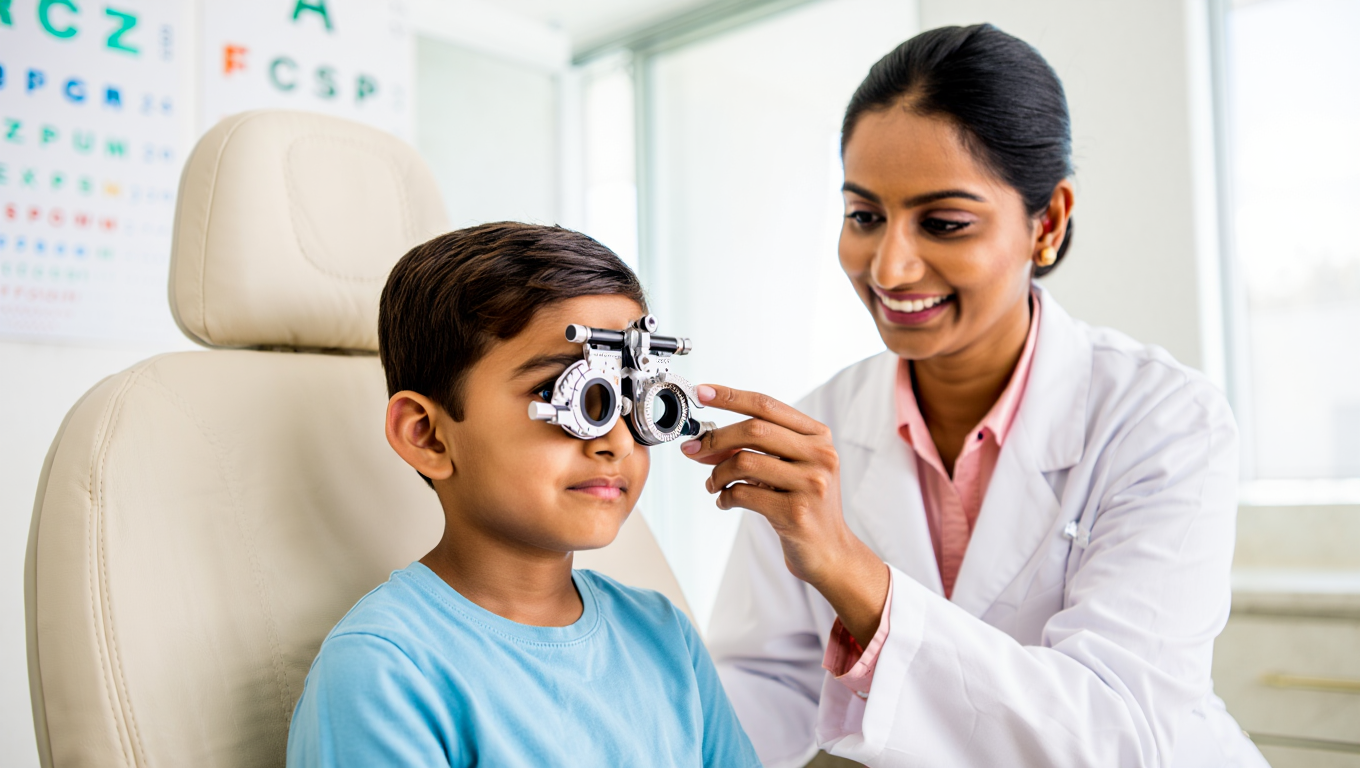
A comprehensive paediatric eye exam at Shine Eye Clinic is tailored to the child's age and level of cooperation. It typically includes:
- Visual acuity testing using age-appropriate charts (including picture charts for pre-readers)
- Refraction — determining if glasses are needed (can be done without the child needing to read)
- Cover test and eye movement assessment to check for strabismus
- Binocular vision and depth perception evaluation
- Slit-lamp examination of the front of the eye
- Retinal examination after pupil dilation
- Colour vision testing (for school-age children)
The exam is child-friendly, non-invasive, and typically takes 30–45 minutes. Cycloplegic drops (which temporarily dilate the pupils and relax focus) are often used for accurate refraction in children.
The Bottom Line
If you have noticed any of these warning signs in your child, don't wait. Book a comprehensive paediatric eye examination at Shine Eye Clinic. Treating vision problems early gives your child the best possible chance of achieving full visual potential — and makes learning, sport, and everyday life significantly easier and more enjoyable.
Senior Ophthalmologist at Shine Eye Clinic. Specialises in comprehensive eye care, refractive surgery, and paediatric ophthalmology. Committed to making quality eye care accessible to every patient.